 Carphophis (common name worm snakes) is a genus of small colubrid snakes. The genus consists of two species, which are divided into the eastern and western types. They are found only in the eastern half of the United States.
30.12.09


Some species that are similar to the Eastern Ribbon Snake are the Western Ribbon Snake, Common Gartersnake, Plains Gartersnake, and the Butler Garter Snake. (Mayer 2003)
The subspecies to the Eastern Ribbon Snake is the Northern Ribbon Snake T. s. septentrionalis. (Mayer 2003)
Description
The Eastern Ribbon Snake gets its name from its very thin body. At maturity it can be anywhere from 18 to 86 cm in length. (Kingsbury 2007) It is a slender black snake with a yellow midback stripe and one on each side. A brown stripe that is 1-2 rows of scales extends onto the sides of the belly. The rest of the belly is a greenish white color. They also have two rows of black spots between the back and side stripes. It also has a long tail that is about a third of the length of its body.(Mayer 2003) The labial scales around the mouth of the snake are unmarked and uniformly bright yellow or white. A white or light yellow bar borders the front of their eyes. (Kingsbury 2007) Juveniles are colored like adults. (Towson University 2007) Here are some aspects of the Eastern Ribbon Snake that make it different from a close relative, the Garter Snake. The Eastern Ribbon Snake has a much thinner body than a Garter Snake. It also has a tail that makes up about one third of its body length. This snake has stripes on the third and fourth scale rows. The Eastern Ribbon Snake has pure white lips and a mark of White color in front of its eyes. These characteristics make it easy to tell the difference between the snakes but it may help to have one of each on hand to look at (Crowe 2006). Eastern Ribbon Snake (below left) has a dot in front of its eye, whereas the Garter Snake (below right) does not.Eating Habits

Behavior
Thamnophis Sauritus Sauritus likes to stay active year around. However, when the colder months set in the snakes may be forced to hibernate. It typically hibernates in ant mounds, vole tunnels, crayfish burrows, muskrat lodges, and bank burrows. Ribbon Snakes rarely bite when handled but they do produce a foul musk from their anal glands when they feel threatened. (Buchanan 2007)Reproduction and Care of the Young
Reproduction in Eastern Ribbon Snakes takes place after they emerge from hibernation in the spring time, in April or May. Mating occasionally takes place in the fall, but the female will delay fertilization and development until the next spring. The average gestation period is three months. They average number of young is around 12 but can range anywhere from 4-27. Females give birth in late summer or maybe even the early fall. After birth there is no parental care involved, the young are left to fend for themselves. Most young reach sexual maturity after two years, but most usually wait until the third year. (Towson University 2007)[hide]

Appearance
Milk snakes have smooth and shiny scales and their typical color pattern is alternating bands of red-black-yellow or white-black-red.[1] However, red blotches instead of bands are seen in some populations.[1] Some milk snakes have a striking resemblance to coral snakes and this mimicry (known as Batesian mimicry) likely scares away potential predators. While both milk snakes and coral snakes possess transverse bands of red, black and yellow, a common mnemonic can be used to properly distinguish between the deadly coral snake and the harmless milk snake:-
Habitat
Across the wide range of this species, habitat varies. Typically, milk snakes live in forested regions, however, in some regions they can be located in open prairies. In various parts of across its distribution, milk snakes often abide in rocky slopes.Behavior
Milk snake activity is mostly nocturnal. They are primarily terrestrial, except the scarlet kingsnake which is known to take shelter under the bark of standing dead trees. and dead leaves they try to blend inReproduction
Milk snakes are oviparous, laying an average of about 10 eggs per clutch, although that number may vary by region.[1] The milk snake mates from early May[3] to late June. In June and July, the female lays three to twenty-four eggs beneath logs, boards, rocks, logs and rotting vegetation.[3] The eggs incubate for approximately two months, and hatch around August or September.[3] Milk snakes typically live around twelve years

Lampropeltis means "shiny shield" (from Greek λαμπρος, "shine" + πελτα, "small shield"), a name given to them in reference to their dorsal scales. The majority of kingsnakes have quite vibrant patterns on their skin. Kingsnakes use constriction to kill their prey and tend to be opportunistic when it comes to their diet; they will eat other snakes (ophiophagy), including venomous snakes, lizards, rodents, birds and eggs. The Common Kingsnake genus are known to be immune to the venom of other snakes and are known to eat rattlesnakes (note - Kingsnakes are not necessarily immune to the venom of snakes from different localities.). The "king" in their name (as with the king cobra) references their taste for other snakes.
Some species of kingsnake, such as the Scarlet Kingsnake, have coloration and patterning which can cause them to be confused with the venomous coral snakes. There are mnemonic rhymes to help people distinguish between the coral snake and its non-venomous look-alikes.
Taxonomic reclassification is an ongoing process, and different sources often disagree, granting full species status to a group of these snakes that another source considers a subspecies. In the case of Lampropeltis catalinensis, for example, only a single specimen exists, and therefore classification is not necessarily finite. In addition, hybridization between species which have overlapping geographic ranges is not uncommon, confusing taxonomists further.
Kingsnakes are commonly kept as pets, due to their ease of care. Kingsnakes are overall hardy and simple to care for. Their captive diet usually consists of appropriately sized rodents, prekilled. Giving live rodents is an illegal offense in some countries and may be bad for the snake's health, as live rodents are capable of delivering powerful bites, potentially injuring the snake. Kingsnakes are generally docile, curious and gentle. Kingsnakes enjoy being handled. They seemed to be mesmerized by patterns flashing on a television.
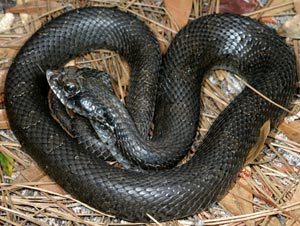
Adults average 71 cm (28 inches) in length, with females being larger than males. The most distinguishing feature is the upturned snout, used for digging in sandy soils.
The color pattern is extremely variable. It color can be red, green, orange, brown, grey to black, or any combination therein depending on locality. They can be blotched, checkered, or patternless. The belly tends to be a solid grey, yellow or cream colored.
These snakes are considered rear-fanged, but any venom they excrete is not considered dangerous to humans and they are not inclined to bite.
Conservation status
This species is classified as Least Concern (LC) on the IUCN Red List of Threatened Species (v3.1, 2001).[4] Species are listed as such due to their wide distribution, presumed large population, or because it is unlikely to be declining fast enough to qualify for listing in a more threatened category. The population trend is stable. Year assessed: 2007Behavior
When threatened, the neck is flattened and the head is raised off the ground, not unlike a cobra. They also hiss and sometimes feign strikes, but are not apt to bite. If this threat display does not work to deter a would-be predator, hognose snakes will often roll onto their back and play dead, going so far as to emit a foul musk from their cloaca and let their tongue hang out of their mouth. If they are rolled upright while in this state, they will often roll back as if insisting they are really dead.Feeding
The eastern hognose snake specializes in feeding on toads, having an immunity to the toxins toads secrete. They will also consume other amphibians, like frogs and salamanders.Captivity
Eastern hognose snakes are frequently available in the exotic pet trade, but due to their difficult dietary requirements they can be a challenge for some keepers. Evidence has shown that eastern hognose snakes fed a diet which includes rodents tend to develop liver problems, and may have a reduced lifespan.[1] In Canada, eastern hognose snakes are considered to be a species-at-risk (COSEWIC designation: Threatened), and consequently capture or harassment of these animals, including their captive trade, is illegal.These snakes live for approximately 12 years. They shed their skin periodically to grow and develop. The females, which lay 10-30 eggs at a time, do not take care of the young. The eggs hatch after about 60 days.
 The common garter snake (Thamnophis sirtalis) is a snake indigenous to North America. Most garter snakes have a pattern of yellow stripes on a brown background and their average length is about 1 metre (3.3 ft) to 1.5 metres (4.9 ft).
Life history
The common garter snake is a diurnal snake. In summer, it is most active in the morning and late afternoon; in cooler seasons or climates, it restricts its activity to the warm afternoons.In warmer southern areas, the snake is active year-round; otherwise, it sleeps in common dens, sometimes in great numbers. On warm winter afternoons, some snakes have been observed emerging from their hibernacula to bask in the sun.
Garter snakes generally mate in March or April, after hibernation. The species is ovoviviparous; females give birth to a litter of 12-15 live young any time from February through December.
Toxicity
The saliva of a garter snake may be toxic to amphibians and other small animals. For humans, a bite is not dangerous, though it may cause slight itching, burning, and/or swelling. Most garter snakes also secrete a foul-smelling fluid from postanal glands when handled or harmed.Reproduction
In the early part of spring, when snakes are coming out of hibernation the males generally emerge first to be ready when the females wake up. Some males will assume the role of a female and lead other males away from the burrow, luring them with a fake female pheromone. After such a male has led rivals away, he "turns" back into a male and races back to the den, just as the females emerge. He is then the first to mate with all the females he can catch. There are generally far more males than females and that is why, during mating season, they form "mating balls," where one or two females will be completely swamped by ten or more males. Sometimes a male snake will mate with a female before hibernation and the female will store the sperm internally until spring, when she will allow her eggs to be fertilized. If she mates again in the spring, the fall sperm will degenerate, and the spring sperm will fertilize her eggs.
Habitat
The habitat of the garter snake ranges from forests, fields and prairies to streams, wetlands, meadows, marshes and ponds, and it is often found near water. It is a semi-aquatic animal like most snakes. It is found at altitudes from sea level to mountain locations. Their diet consists mainly of amphibians and earthworms, but also fish, small birds,toads and rodents. Garter snakes are effective at catching fish and small to medium tadpoles. Animals that eat the common garter snake include large fish, bull frogs, snapping turtles, milk snakes, hawks, skunks, foxes and domestic cats Adults can become quite large and are known to reach up to eight (8) feet, being the largest snake found in Canada. The record length is 101 inches (2,600 mm), making it (officially) the longest snake in North America. Unofficially, indigo snakes (Drymarchon corais) are known to exceed them, and one wild caught pine snake (Pituophis melanoleucus) with a portion of its tail missing measured 111 inches (2,800 mm)
Behavior
When startled, they may freeze and wrinkle themselves into a series of kinks. If they feel further threatened, they may flee quickly or vibrate their tails in dead leaves (a form of mimicry, to make it sound like a rattlesnake). They are also capable of producing a foul smelling musk which they will release onto a predator if picked up. They spread the musk with their tail in hopes of deterring the threatFeeding
This species is a constrictor, meaning it suffocates its prey, coiling around small animals and tightening its grip until they can no longer draw breath, before eating them. Though they do consume mice and rats, the Black Rat Snakes will also hunt other snakes, chipmunks, squirrels, birds, and bird eggs.Reproduction
The male snake wraps its tail around the female with their vents nearly touching. Males then erect their sex organ, the hemipenis, and insert it into the female sex organ, cloaca. The mating lasts about a few minutes or a few hours. The female lays about 12 to 20 eggs after five weeks and they hatch about 65 to 70 days later.[
Subscribe to:
Posts (Atom)